Customer Acquisition Cost (CAC): What It Is and How to Calculate It
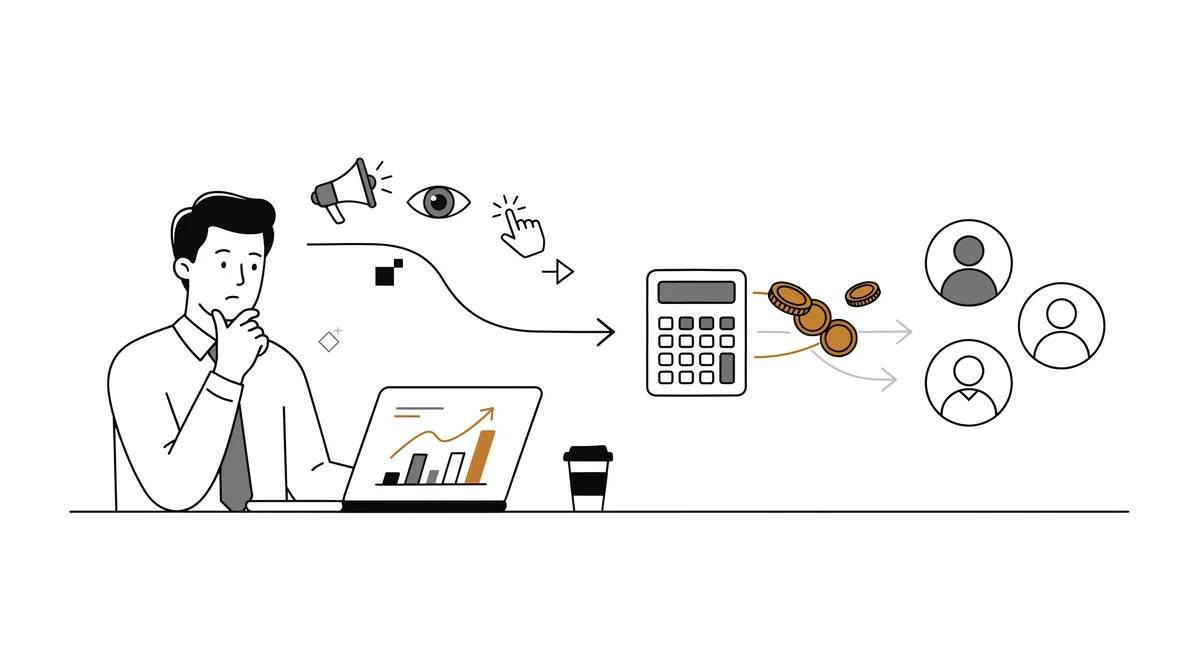
Customer acquisition cost, or CAC, is the average amount you spend to win one new customer. It is the single most important marketing number, because it tells you whether you are building a business or just buying sales at a loss.
How to calculate CAC
The formula is simple: divide everything you spent on marketing and sales in a period by the number of new customers you won in that period.
CAC = total marketing and sales spend ÷ new customers acquired. Spend $1,000 and win 25 customers, and your CAC is $40.
What counts as a good CAC?
There is no universal good number, because it only matters relative to what a customer is worth to you. The real question is the ratio between what a customer pays you over their lifetime (LTV) and what they cost to acquire (CAC).
- ·LTV to CAC of 3:1 or better is generally healthy, a customer is worth at least three times what they cost
- ·Around 1:1 means you are spending a dollar to make a dollar, which is unsustainable
- ·Very high ratios (5:1+) can actually mean you are underspending and leaving growth on the table
How to lower your CAC
- ·Retarget warm audiences, people who already visited you convert several times better than cold traffic and cost less per click
- ·Improve your landing page before spending more; a better conversion rate lowers CAC directly
- ·Lean on referrals and organic channels, which carry little or no acquisition cost
- ·Concentrate budget on your best-performing channel instead of spreading it thin
CAC, CPL and CPA: what is the difference?
People use these terms loosely, and mixing them up leads to bad decisions. They measure different points on the path from stranger to customer:
| Term | What it measures | Example |
|---|---|---|
| CPC (cost per click) | What you pay for a visit | $8.33 per click |
| CPL (cost per lead) | What you pay for an enquiry or contact | $90.92 per lead |
| CAC (customer acquisition cost) | What you pay for a paying customer, all in | $273 per customer |
The first two figures are LocaliQ's 2026 averages for home and home improvement advertisers. The third is arithmetic: a $90.92 lead that closes one time in three works out at about $273 per customer. The key point is that CAC is always higher than cost per lead, because not every lead buys.
From cost per lead to CAC: the close rate does the work
If you know what a lead costs and how often leads become customers, you can estimate CAC before spending a dollar. The table divides LocaliQ's 2026 average cost per lead by the share of leads you close. It is arithmetic, not a forecast:
| Industry (avg cost per lead) | Close 20% | Close 33% | Close 50% |
|---|---|---|---|
| Restaurants and food ($30.57) | $153 | $92 | $61 |
| Dentists and dental ($72.97) | $365 | $219 | $146 |
| Home improvement ($90.92) | $455 | $273 | $182 |
This is why improving your close rate is one of the cheapest ways to lower CAC. Answering the phone faster, following up every enquiry and giving clear prices can move a close rate far more cheaply than buying cheaper clicks. Try your own figures in the advertising budget calculator.
What to include in CAC and what to leave out
- ·Include: ad spend, agency or freelancer fees, marketing software, content and design costs, and the pay of anyone whose job is winning customers.
- ·Leave out: the cost of serving existing customers, and revenue-side costs like materials and delivery, which belong in your margin instead.
- ·Be consistent. Use the same period for spend and for new customers, and write down which version you used so you can compare month to month.
- ·Decide whether to count organic customers. A fully loaded CAC counts every new customer and every cost. A paid CAC counts only customers from paid spend, against only paid spend. Both are useful, so label them.
Estimating lifetime value without a spreadsheet
LTV does not need to be precise to be useful. Multiply what a customer pays you in a typical month by your gross margin, then by the number of months a typical customer stays. For example, a customer who pays $100 a month, at a 60% gross margin, who stays 18 months, has an LTV of $1,080. If your CAC is $200, that is a ratio of about 5.4 to 1. The customer acquisition cost calculator does this arithmetic for you and shows the payback time.
If you have never calculated CAC, do the rough version today: last month's total spend on winning customers divided by the number of new customers. It will not be perfect, but a rough number you can improve beats a precise one you never calculate.
Payback: the number that protects your cash
A healthy LTV to CAC ratio is not enough if it takes two years to earn your money back. Payback time is CAC divided by the monthly gross profit from a customer. In the example above, $200 divided by $60 a month is about 3.3 months. Short payback means you can reinvest quickly and grow. Long payback means you need cash to survive the wait, even if the ratio looks fine on paper.
A worked example, from spend to verdict
Imagine a small home-services company that spends the following in a month, with these results. The numbers are invented to show the method, not to predict yours:
| Channel | Spend | New customers | CAC |
|---|---|---|---|
| Google Ads | $1,500 | 6 | $250 |
| Facebook and Instagram ads | $600 | 4 | $150 |
| Referral rewards | $100 | 2 | $50 |
| All channels together | $2,200 | 12 | $183 |
The blended CAC of $183 hides the story. Referrals are the cheapest customers, Facebook is cheaper than Google, and Google is the most expensive. That does not automatically mean cutting Google, because the customers it brings may be worth more. The next step is to compare each channel's CAC with the profit from the customers it delivers, then move money toward the channels where the gap is widest. This is the discipline behind the advertising budget calculator as well.
When CAC is the wrong number to chase
A lower CAC is not always better. If you cut your cost per customer by switching to cheaper, lower-quality leads, the customers may leave sooner and be worth less, and your LTV to CAC ratio gets worse even as CAC improves. Judge any change by the ratio and the payback time, not by CAC alone.
CAC also behaves differently for a subscription business and a one-off seller. A subscription can afford a higher CAC because revenue keeps arriving, as long as cash can cover the months before payback. A one-off seller needs the first sale to cover the cost, so its break-even close rate matters more. The advertising budget calculator shows that break-even directly when you enter the value of a sale.
Five practical ways to lower CAC
- 1.Raise your close rate. Reply to every lead fast, follow up, and publish clear prices.
- 2.Improve the page the ad points to. A page that matches the ad converts more of the same clicks.
- 3.Lean on referrals and reviews, which carry little acquisition cost.
- 4.Cut the weakest channel and put its budget into the strongest, rather than spreading evenly.
- 5.Raise prices or retention. A higher value per customer makes any CAC easier to afford, so improving LTV is another way to fix the ratio.
Frequently asked questions
What is a good customer acquisition cost?
It depends on what a customer is worth to you. A $200 CAC is excellent for a customer worth $2,000 and unsustainable for one worth $150. Compare CAC with gross profit per customer and with lifetime value, not in isolation.
Is CAC the same as cost per lead?
No. Cost per lead measures an enquiry, and CAC measures a paying customer. CAC is cost per lead divided by the share of leads that become customers, so it is always higher.
How often should I calculate CAC?
Monthly is enough for most small businesses, with a longer view each quarter to smooth out seasonality. Track it by channel once you use more than one. If you have almost no customers yet, start by winning your first 10 customers by hand, then measure.
Can CAC be too low?
A very low CAC can mean you are underspending and leaving growth on the table, as long as new customers keep coming at a profitable cost. If doubling spend keeps cost per customer steady, you are not yet at your ceiling.
Know your CAC before you spend
You can estimate your likely CAC for your industry, budget, and country before spending a dollar. The free tool shows your projected cost per customer and how many sales it takes to break even.
Get a marketing plan for your business
Channels, budget math, audience, and hidden platforms, matched to your exact business and country. Free, no signup.
Build my free strategyRelated business guides