How to Get Your First 10 Customers (Before You Spend on Ads)
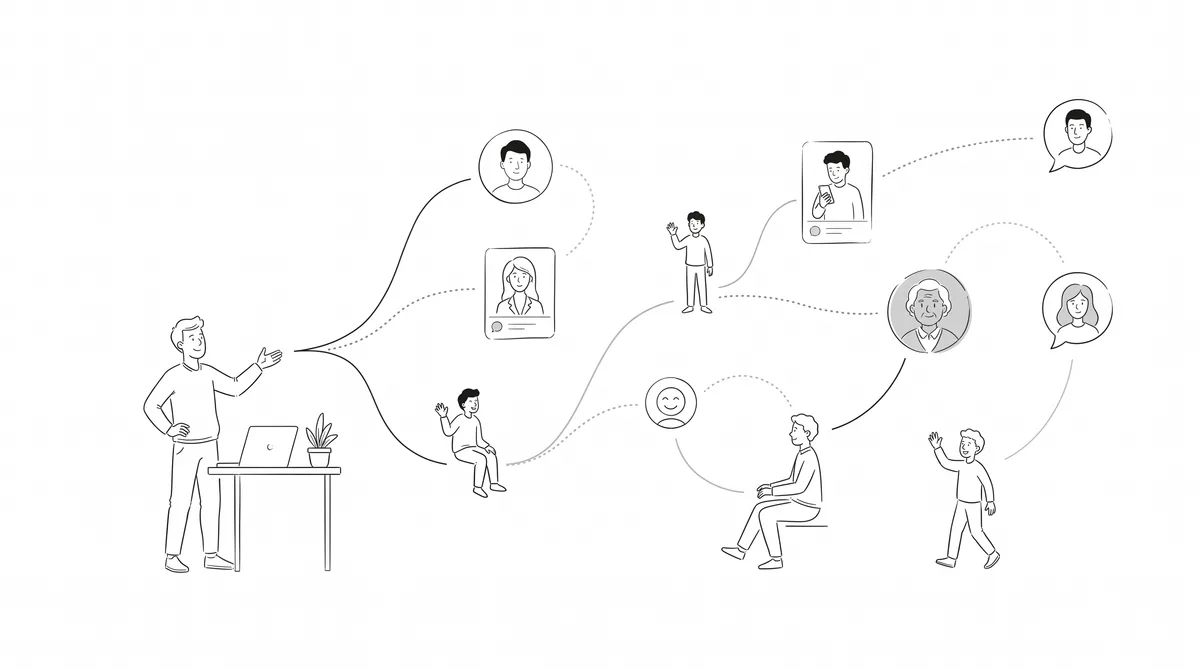
The first ten customers are different from every customer after them. They are not won by marketing systems; they are won by hand, one conversation at a time. That is not a weakness of your business, it is the phase every business goes through, and skipping it with ads is the most expensive mistake a new founder makes.
Why ads are the wrong tool at zero
Ads amplify something that already works. At zero customers you do not yet know your best message, your real price, or the objection that stops people, so ads amplify guesses. Worse, ads deliver strangers, and strangers give you no feedback when they leave. Your first ten customers should be close enough to tell you the truth.
Step 1: your warm circle, without shame
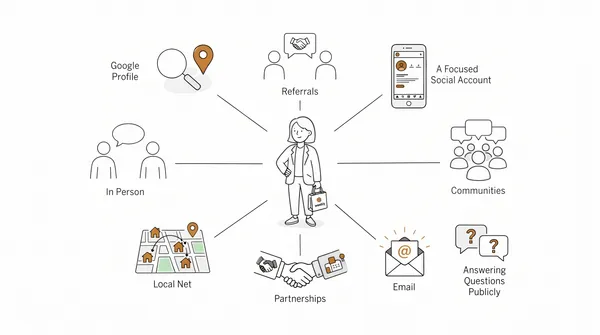
Write a list of 50 people who know you: friends, family, former colleagues, neighbors, group chats. Message each one personally, not a broadcast, with one sentence about who you help and one direct ask: "who do you know that needs this?" You are not asking them to buy; you are asking them to route. Warm intros convert at rates paid traffic never touches.
Step 2: go where the asking already happens
Every day, people publicly ask for exactly what you sell: Nextdoor threads, Facebook Groups, Reddit, "any recommendations?" posts. Set 20 minutes a day to find and answer these with genuine help. One thoughtful reply to a real request beats a hundred impressions on someone who never asked.
Step 3: the founding-customer offer
- ·Make the first-customer deal explicit: a real discount or bonus in exchange for a review and honest feedback
- ·Frame it honestly: "You are one of my first customers, so you get X and I get to learn from you"
- ·Cap it and say so, "first 10 only", scarcity that is true works without tricks
- ·Deliver conspicuously well. Your first ten customers are your entire reputation
Each early customer is worth more as information than as revenue. Ask every one: how did you find me, what almost stopped you, what would you tell a friend? Those three answers are your future marketing, written by the market itself.
Step 4: turn ten into twenty
The moment a customer is happy is the moment to ask for the next one: a review, a referral, a share. Ten happy customers each sending one more is your second ten at zero cost. Only after that, when you know your message, your price, and your best channel from real conversations, is it time to put money behind it.
A 14-day outreach schedule
Winning ten customers by hand is mostly a matter of steady, daily conversations. This schedule turns the four steps above into a plan you can follow for two weeks. It assumes about an hour a day, and you can scale it up or down:
| Days | Focus | Target |
|---|---|---|
| 1 to 2 | Build your list of 50 people and write your one-sentence description of who you help | A finished list and a message you are happy to send |
| 3 to 5 | Message the warm circle personally, five to ten people a day | Every name contacted once, with replies logged |
| 6 to 8 | Join two communities where your customers ask for help and answer questions | Several genuinely useful public answers |
| 9 to 11 | Follow up with everyone who replied, and make your founding-customer offer | Your first conversations about price and start dates |
| 12 to 13 | Deliver to the first customers, exceptionally well | Happy customers with something to say |
| 14 | Ask each for a review, a referral and honest feedback, then review the log | A written list of what worked and what to change |
Three scripts you can adapt
To someone who knows you
"Hi Alex, quick favour. I have started [business] to help [who] with [problem]. I am looking for my first few customers and would value your honest view. Do you know anyone who might need this, or could I show you what I am doing for five minutes?"
To a person who asked for help in a community
"I saw your question about [topic]. Here is how I would approach it: [two or three specific steps]. I do this for a living, so if it would help I am glad to look at your situation. No pressure either way."
To follow up after a first conversation
"Thanks for chatting yesterday. Based on what you said about [their problem], I would suggest [specific next step]. I can start on [date]. Would you like me to send over the details?" Be specific, make the next step easy, and follow up once more if you do not hear back.
What to charge your first customers
A founding discount is useful, but do not undervalue the work. If your first customers pay almost nothing, you learn little about what the market will really pay. A sound approach is to quote your real price and then offer a clear, time-limited bonus or reduced rate in return for a review and feedback. That way the full price stays visible, and the discount is tied to something you want. Adjust as you learn from the objections you hear.
Keep a feedback log
After each conversation, record the same few things so patterns show up quickly:
| Question | Why you ask it |
|---|---|
| How did they find you or hear about you? | Shows which source to repeat |
| What problem were they trying to solve? | Gives you your headline |
| What almost stopped them? | Shows the objection to answer in advance |
| What words did they use to describe you? | Tells you how the market sees you |
| What did they say to a friend afterwards? | The best testimonial you will ever get |
What the first ten customers teach you
- ·Your real message. The words customers use to describe the problem are the headline you could not write alone.
- ·Your real price. How people react tells you whether you are too cheap, too expensive or about right.
- ·Your real objection. The same worry will come up again and again, and you can answer it before it is asked.
- ·Your real channel. If several came from the same place, that is where to put your next hour or dollar.
- ·Your real limit. Delivering to ten customers shows what you can handle, and what to fix before there are fifty.
Write these five lessons down at the end of the two weeks. They are worth more than the revenue, because every later marketing decision rests on them.
Signs you are ready to scale
- ·You can explain in one sentence who you help and why, and strangers understand it.
- ·You know your real price and what customers say when they hear it.
- ·At least a few customers came from the same source, so you have something to repeat.
- ·You can estimate what it cost you to win a customer, including your time. The CAC calculator works it out.
- ·You have reviews and a story people can see, so ads do not send strangers to an empty page.
When most of these are true, test one paid channel with a small, capped budget. The advertising budget calculator shows what to expect in your industry, and the one-page marketing plan keeps the test disciplined.
Mistakes that slow the first ten
- ·Waiting until everything is ready. Your offer improves fastest in conversation with real people.
- ·Sending one mass message instead of personal ones. Warm contacts respond to being asked directly.
- ·Pitching in the first sentence in communities. Help first, and let people ask about you.
- ·Not following up. Many sales happen on the second or third contact.
- ·Forgetting to ask for reviews. Your Google reviews are the proof that makes the next ten easier.
Frequently asked questions
How long does it take to get your first 10 customers?
It varies widely with the business, the price and how many conversations you have. The pace usually follows the number of genuine conversations, so focus on that number rather than a deadline.
Should I run ads to get my first customers?
Usually not yet. Ads amplify a message that already works, and you are still discovering yours. Start with direct outreach and use ads once you know what converts. See how much to spend on marketing for setting a first budget.
What if my friends and family are not my customers?
They can still introduce you to people who are. Ask for introductions rather than purchases, and use the same approach with former colleagues and neighbours.
What should I do after the first ten?
Review what you learned, repeat the source that worked best, and follow the first 30 days plan to build a repeatable routine.
Know your numbers before you scale
When you are ready to move from hand-won customers to a repeatable channel, the free tool shows which channel fits your exact business and what a customer should cost you there, so your first ad dollar lands on evidence, not hope.
Get a marketing plan for your business
Channels, budget math, audience, and hidden platforms, matched to your exact business and country. Free, no signup.
Build my free strategyRelated business guides