Should You Hire a Marketing Agency? An Honest Decision Guide

At some point every owner asks it: should I just pay someone to do this? The honest answer, the one agencies will not give you, is that below a certain budget, an agency mathematically cannot work for you, and above it, the right one is often worth every dollar. Here is how to know which side you are on.
The math nobody shows you
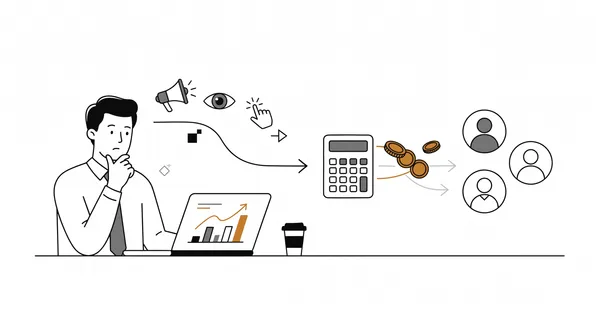
A competent agency retainer commonly starts in the low thousands of dollars per month, before a single dollar of ad spend. If your total marketing budget is $1,500, an agency means $1,000 to management and $500 to actual ads: two-thirds of your money buys oversight of one-third. The general rule: agency management should be a minority of your total spend, which means agencies tend to start making sense once you spend several thousand dollars a month all-in.
What each option really buys
- ·DIY: cheapest in cash, most expensive in your hours. Right at the start, and the knowledge you gain makes you impossible to fool later
- ·Freelancer or contractor (often roughly $500-1,500 a month): one skilled person on your one most important channel. The best middle step for most small businesses
- ·Agency (often from the low thousands a month): a team, processes, and breadth across channels. Right when spend is high enough that their management fee pays for itself in saved waste
- ·In-house hire: rarely right below several thousand a month in sustained spend, but unbeatable on context when you get there
When an agency genuinely wins
You are spending enough that a 20% efficiency gain covers their fee. Your time is worth more in the business than in the ads manager. You need skills that take years to build, media buying at scale, technical SEO, creative production. And crucially: you already know your numbers, so you can tell whether they are performing. An agency managing a business that does not know its own cost-per-customer is unaccountable by definition.
Red flags, in order of severity
- ·Guaranteed results ("first page of Google in 30 days"), nobody honest guarantees outcomes they do not control
- ·They own your ad accounts, if leaving them means losing your data and history, do not start
- ·Long lock-ins before any results: 12-month contracts with no exit clause protect them, not you
- ·Reports full of impressions and "engagement" but no cost-per-lead or revenue: vanity reporting hides non-performance
- ·Same pitch for every business: if they proposed the plan before understanding your market, it is a template
The one question that filters most bad agencies: "What number will you report to me monthly, and what happens if it is bad?" Good agencies answer with a cost-per-customer target and a plan-B. Bad ones answer with reach.
Questions to ask before you sign anything
A good agency welcomes hard questions, and a poor one gets vague. Ask these in the first meeting and write down the answers:
| Question | What a good answer sounds like |
|---|---|
| Who will actually work on my account? | Named people, with their role and how much time they will give you |
| What will you report each month, and what happens if it is bad? | A cost per lead or customer target, a review process and a plan B |
| Who owns the ad accounts, data and creative? | You do, with admin access for them, so you can leave cleanly |
| What is the contract length and how do I exit? | Short initial terms, or a clear notice period and no penalty for leaving |
| Can I speak to a current client in a similar business? | Yes, with a real reference you can call |
| What do you need from me? | Specific inputs and response times, not "just leave it to us" |
| What have you done for a business like mine, and what did it cost the client per customer? | Concrete cases with figures, and honesty about what did not work |
What a good first 90 days looks like
- 1.Days 1 to 15: a proper discovery. They study your customers, your numbers and your competitors, and agree a measurable target with you.
- 2.Days 16 to 45: set-up and first tests, with tracking in place so every lead can be traced to a source.
- 3.Days 46 to 75: they read the early data, cut what is not working and put more behind what is.
- 4.Days 76 to 90: a clear review with your cost per customer against the target, and a recommendation to continue, change or stop.
If you reach day 90 with plenty of activity but no figure you can compare with the target, treat it as a warning. Good work is easy to measure.
Write a one-page brief
An agency can only be as good as the brief you give. Write one page covering the following, and you will get better proposals and fewer misunderstandings:
- ·What you sell, who buys it and what a customer is worth to you.
- ·Your goal as a number, such as customers a month at a maximum cost per customer.
- ·Your total monthly budget, including both fees and ad spend.
- ·What you have tried and what happened.
- ·Your main competitors and what makes you different.
- ·What you will provide: access, photos, approvals and a named contact.
Know your numbers so you can judge the results
The owner who knows what a customer should cost is hard to mislead. Before you hire anyone, use the advertising budget calculator to see typical costs per click and per lead in your industry, and the CAC calculator to work out what a customer is worth. Then ask the agency to commit to a target that makes sense against those figures. If their promised cost per lead is far below the industry average, ask them to explain exactly how, because the average reflects what thousands of advertisers actually pay.
How to read a proposal critically
A proposal tells you how an agency thinks. Look for specifics about your market, your customers and your numbers, rather than a generic list of services. Check that each activity is linked to a goal you can measure, that costs are broken into fees and ad spend, and that the timeline says when you will see data. Be wary of a proposal that could have been sent to any business with the name changed, or that promises rankings, followers or sales without explaining how they will be achieved. If a proposal is vague, ask for a revised version before you decide.
Agency, freelancer, or an in-house hire?
| Option | Best when | Watch out for |
|---|---|---|
| Do it yourself | You are starting out and have more time than money | Your hours are the cost, and learning takes time |
| Freelancer | You need one skill on one channel, such as search ads or email | Single point of failure, and limited breadth |
| Agency | You have a proven offer, a sizeable budget and little time | Management fees, handoffs and generic work |
| In-house | Marketing is central and spend is large and steady | Salary cost and the need to manage and train |
Contract terms worth negotiating
- ·You own all ad accounts, websites, domains, creative and data, and keep access throughout.
- ·A short initial term or a trial period, with a clear exit.
- ·Agreed reporting that includes cost per lead and cost per customer, not only impressions.
- ·A clear scope: what is included, what costs extra and who pays for ad spend.
- ·Written agreement on any minimum spend, so the fee is a sensible share of the budget.
Warning signs during the engagement
- ·Reports that celebrate impressions and followers but never mention customers or revenue.
- ·Slow or evasive answers when you ask for access or the source of a number.
- ·Frequent changes of the person handling your account.
- ·Blaming the market or your product for every missed target without a plan.
- ·Pressure to raise spend before there is evidence the current spend works.
Frequently asked questions
How much should I pay a marketing agency?
Agency fees vary widely with scope and market, and many start in the low thousands of dollars a month before ad spend. As a rule, management should be a minority of your total budget, so check the maths against the marketing budget calculator before you commit.
Can I do the first steps myself and hire later?
Yes, and it often works best. Learning your numbers first, through the first 30 days plan, makes you a better client and protects you from paying for what you could do yourself.
What if I cannot afford an agency?
Use a freelancer for one channel, or focus on free channels and learn as you go. Many businesses grow well that way until spend justifies a team.
Does an agency guarantee results?
No honest agency can guarantee outcomes it does not control, such as rankings or sales. Look for guarantees about work and reporting, plus a clear target and a plan if it is missed.
Whichever you choose, know your numbers first
DIY, freelancer, or agency, the owner who knows what a customer should cost cannot be fooled by any of them. The free tool gives you those benchmarks for your exact business, budget, and country. Take them into every conversation.
Get a marketing plan for your business
Channels, budget math, audience, and hidden platforms, matched to your exact business and country. Free, no signup.
Build my free strategyRelated business guides