How Much Should a Small Business Spend on Marketing in 2026?
If you have ever asked "how much should I spend on marketing," you have probably been given a vague answer. Here is a clear one, plus the reasoning so you can decide for your own business.
The percentage-of-revenue rule
The most widely used benchmark is to spend between 7% and 15% of revenue on marketing. Established businesses that mostly need to maintain their position sit at the lower end. New businesses trying to grow fast, or those in crowded markets, push toward the higher end and sometimes beyond.
- ·Established business, steady growth: 7-10% of revenue
- ·Growth-focused or competitive market: 10-15% of revenue
- ·Brand-new business with no revenue yet: work from a fixed monthly amount you can sustain for at least six months, not a percentage
The percentage rule breaks down for a business that has not launched, because there is no revenue to take a percentage of. If that is you, flip the question: what is the most you can spend every month for the next six months without hurting the business? Marketing rarely works on the first try, so you need enough runway to test, learn, and improve.
What your budget actually buys
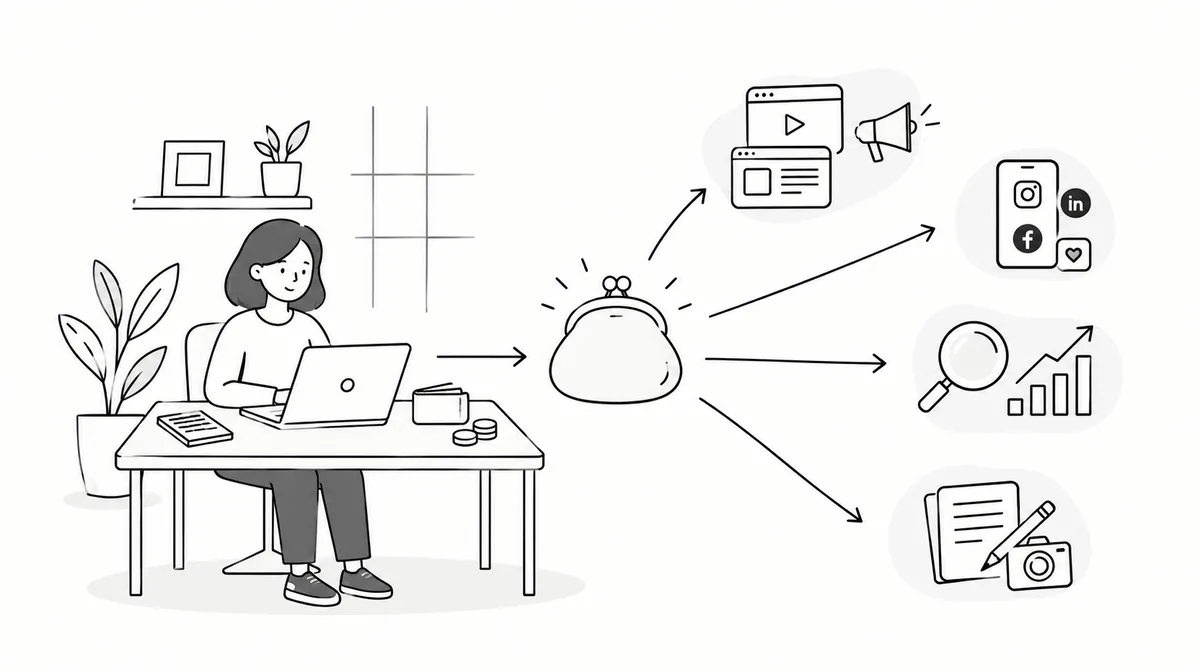
A budget only means something once you translate it into customers. The chain looks like this: your money buys impressions, a fraction of those become clicks, and a fraction of clicks become customers. The exact ratios depend on your industry and where your customers are.
For example, in the US a $500 monthly budget on paid social typically reaches tens of thousands of people and, depending on the industry, produces anywhere from a handful to a few dozen new customers. In markets where advertising is cheaper, the same $500 goes much further.
A budget in one country is not the same as the same budget in another. Ad costs in the US are among the highest in the world, so a modest budget elsewhere can behave like a much larger one.
How to make a small budget work
- ·Pick one hero channel and go deep, instead of spreading thin across five
- ·Reserve about 10% for testing new ideas so you keep improving
- ·Set aside roughly 20% of paid spend for retargeting people who already visited you, they convert several times better than cold audiences
- ·Lean on free channels (your Google Business Profile, referrals, communities) while paid scales
The single biggest mistake is spending evenly across many channels. Concentration wins: find the one channel where your customers already are, prove it works, then expand.
What the benchmarks actually say
Gartner's 2026 CMO Spend Survey, which polled 401 senior marketing leaders (mostly at large companies), put marketing budgets at about 7.7% to 7.8% of company revenue. That is a useful anchor, but it describes big organisations with established brands. A small business that still needs to be found usually plans a little higher, which is why the planning bands in this guide run from 7% up to 15%.
Treat every percentage as a planning range, not a law. A business with fat margins and a loyal base can run lean. A business entering a crowded market, or one that has to win customers every single month, has to spend more to be seen.
What the bands look like in dollars
For example, take a business with $250,000 in yearly revenue. This is arithmetic on the bands above, not a prediction:
| Stage | Share of revenue | Yearly budget | Monthly budget |
|---|---|---|---|
| Established, steady | 7% to 10% | $17,500 to $25,000 | $1,458 to $2,083 |
| Growing or competitive | 10% to 15% | $25,000 to $37,500 | $2,083 to $3,125 |
You can run your own numbers in the marketing budget calculator, which also shows roughly how many leads that budget could buy in your industry.
Work out your number in four steps
- 1.Start with last year's revenue, the real total, not a hope. If you are new, skip to step 4.
- 2.Pick the band that matches your situation. Be honest about whether you are maintaining or pushing for share.
- 3.Divide by 12 for a monthly figure, then subtract the fixed costs of marketing you already pay for: your website, email software, listings and any retainer.
- 4.Sanity-check the result against what customers cost. Put the monthly figure and your industry into the advertising budget calculator to see roughly how many leads and customers it could produce. If the answer is too few to matter, the budget is too small for paid ads and should go to free channels first.
What the same $1,000 buys in different industries
A budget only means something once you translate it into leads, and the cost of a lead varies enormously by industry. LocaliQ's 2026 benchmarks of US small-business Google Ads campaigns show the average cost per lead below. Dividing $1,000 by each average gives the rough number of leads a month, if the whole budget went to Google Ads:
| Industry | Average cost per lead | Leads from $1,000 |
|---|---|---|
| Restaurants and food | $30.57 | about 33 |
| Beauty and personal care | $39.25 | about 25 |
| Dentists and dental services | $72.97 | about 14 |
| Home and home improvement | $90.92 | about 11 |
| Real estate | $102.51 | about 10 |
| Attorneys and legal services | $131.63 | about 8 |
Two businesses with the same budget are in completely different positions. The restaurant gets a steady stream of low-value leads. The lawyer gets a handful of leads that are each worth far more. That is why a percentage-of-revenue rule is only the start: the second question is always what a customer is worth to you.
Where the money should go first
Spend in this order, and do not move to the next step until the one before it is working:
- 1.Free foundations that cost only time: a complete Google Business Profile and a steady habit of asking for reviews.
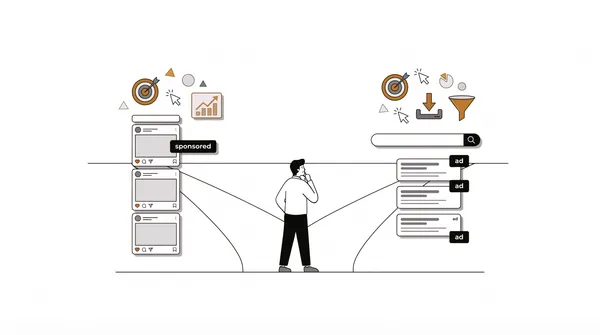
- 2.One paid channel where your customers already look. If people search for what you sell, that is usually Google. If your product sells by being seen, it is usually Instagram and Facebook. The comparison of Facebook and Google ads explains how to choose.
- 3.A small testing slice for new ideas, and a slice for retargeting people who already visited you.
- 4.Only then a second paid channel, an agency or a bigger creative production.
Common budgeting mistakes
- ·Setting a budget by feel and never comparing it with what a customer costs. The budget should follow your customer economics, not the other way round.
- ·Spreading a small budget across five channels, so none of them gets enough volume to teach you anything.
- ·Cutting marketing the moment sales dip. Demand returns to the businesses that stayed visible, and often the quiet months are cheaper to advertise in.
- ·Counting only ad spend. Tools, design, photography and any freelancer are marketing costs too, and they belong in your CAC. The customer acquisition cost calculator shows how to count them.
- ·Changing the plan every week. Give any channel enough time and money to produce a readable result before judging it.
Review the budget on a fixed monthly date
Put one date in your calendar each month and look at three numbers: what you spent, how many customers came from that spend, and what a customer cost. If a channel produces customers for less than they are worth, give it more. If it does not, fix the offer or page before adding money, or cut it. A budget that is reviewed monthly beats a perfect one that nobody checks.
Frequently asked questions
Should I spend more on marketing when sales are slow?
Usually you should hold steady or shift money to the cheapest, fastest channels rather than cut to zero. Pull back only the spending that is not producing customers at an acceptable cost, and keep the free work (reviews, profile updates, replies) going. The slow season guide covers how to plan around predictable dips.
Is the marketing budget a percentage of revenue or of profit?
The common rule of thumb uses revenue. If your profit margin is thin, start at the low end of the range and track results closely before raising it.
How long before I see results from a marketing budget?
Paid ads can produce leads within days, but it usually takes a few weeks of data to know whether a channel works at an acceptable cost. Organic work like reviews, content and referrals builds more slowly and compounds. Plan on at least three months before judging the overall approach, and review monthly.
What if I am brand new and have no revenue?
Skip the percentage. Decide the most you can spend each month for six months without hurting the business, then follow the order above. The first 30 days plan shows how to use a small amount well.
Get the exact numbers for your business
Rather than guess, you can get a projection built for your specific business, budget, and country in under a minute, including expected customers, cost per customer, and how many sales it takes to break even.
Get a marketing plan for your business
Channels, budget math, audience, and hidden platforms, matched to your exact business and country. Free, no signup.
Build my free strategyRelated business guides