How to Start a Referral Program That Actually Gets Used
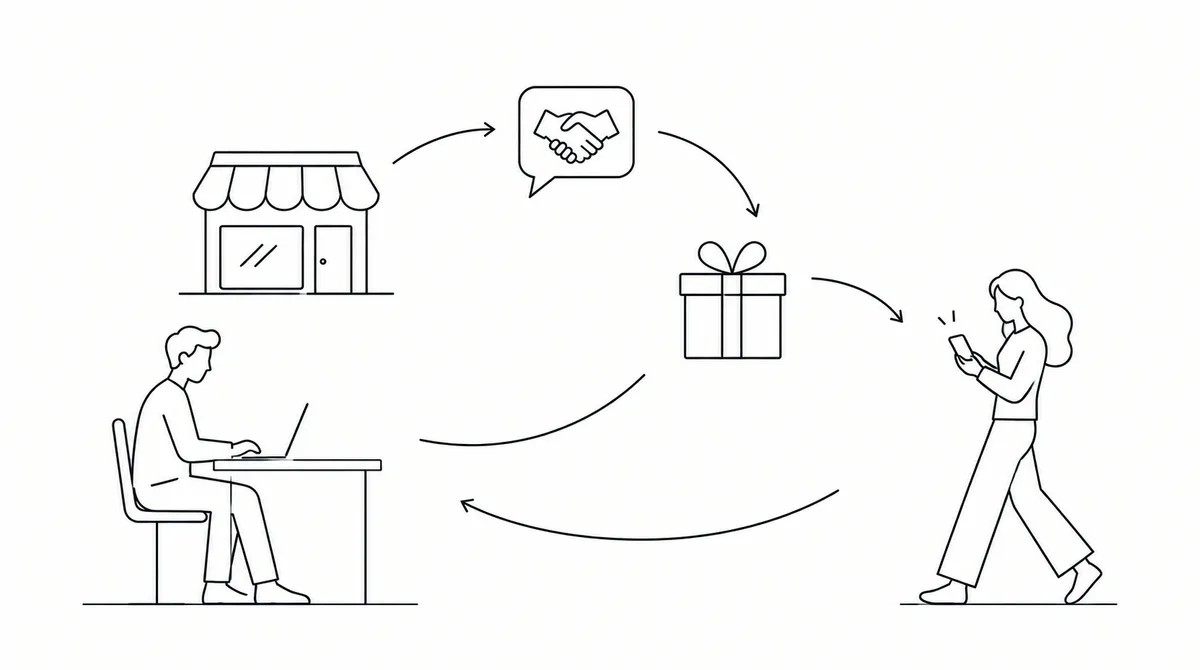
A referred customer is the best customer you can get: they arrive pre-trusting you (a friend vouched), they cost a fraction of an advertised customer, and they tend to stay longer and refer onward. Yet most small business referral programs get built, announced once, and never used again. The failure is almost never the reward, it is friction and timing.
Design choice 1: reward both sides
One-sided programs ("get $20 for referring a friend") quietly put your customer in an awkward spot: they profit from their friend. Two-sided programs ("give a friend $20 off, get $20 when they book") turn the referrer into a gift-giver instead of a salesperson. The give-side reward is what makes people actually share; the get-side just says thank you.
Design choice 2: make sharing effortless
- ·One link or one code, textable in two taps, if sharing requires explaining, nobody shares
- ·Give them the words: a pre-written message they can forward as-is ("I use [business] for X, this link gets you $20 off")
- ·Physical businesses: cards at checkout work, two cards, "one for you, one for a friend"
- ·Track it simply: even "who sent you?" asked at every first visit, logged in a spreadsheet, beats untracked
Design choice 3: ask at the peak, every time
Announcing a program once is not a program. The ask has to live inside your delivery: right after the great result, in the thank-you message, at the moment they compliment you. "So glad you love it, if you know anyone who needs this, this link gives them $20 off and you $20 back." Every happy customer hears it, always, at their happiest moment.
What to offer, by business type
- ·Services (salon, trainer, cleaner): a discount or free add-on on the next visit for both sides, it also drives the rebooking
- ·E-commerce: give $X / get $X store credit; credit beats cash because it comes back as revenue
- ·Subscriptions and memberships: a free month for both sides is the classic for a reason
- ·High-ticket (contractors, B2B, weddings): real money or a serious gift, a $2,000 job deserves more than a coffee card
Size the reward against what a customer is worth, not what feels generous. If your average customer brings you $400, a $25-per-side referral cost is a bargain versus what ads charge for a colder customer.
Keep it honest and simple
No fine print that punishes enthusiasm, rewards paid quickly and cheerfully, and one rule everyone can repeat in a sentence. The moment a customer has to ask how the program works, it has already failed.
Why a referral reward is usually a bargain
The easiest way to size a reward is to compare it with what it costs to win a customer another way. For example, suppose you pay $25 to the person who refers and $25 to the new customer, so each referred customer costs $50 in rewards. If winning a customer through ads costs about $200, the referral is a quarter of the price, and the referred customer usually arrives already trusting you. Work out your own figures with the CAC calculator and set the reward well below that number.
For a lower-value business, the same logic applies at a smaller scale. A coffee shop might give a free drink to both people, which costs a few dollars but brings in a new regular. What matters is that the reward is a fraction of what the customer is worth over time.
Types of referral program, compared
| Type | How it works | Best for |
|---|---|---|
| Two-sided discount | Both people get a discount on their next purchase | Services and shops with repeat business |
| Store credit | The referrer earns credit toward future purchases | E-commerce, because credit returns as revenue |
| Free month or session | Both get a free period or class | Subscriptions, gyms and memberships |
| Cash or gift card | A set amount paid for each successful referral | High-ticket jobs and B2B |
| Charity donation | A donation is made in the customer's name | Community-minded brands |
| Upgrade or exclusive access | A bonus tier or early access to new items | Brands with an enthusiastic fan base |
How to track referrals without fancy software
- ·Ask every new customer "who sent you?" and record the answer in your sales sheet.
- ·Give each referrer a simple code or a personal link, so the source is clear without asking.
- ·For in-person businesses, use numbered referral cards and note the number at the first visit.
- ·Keep one sheet with the referrer, the new customer, the date and the reward paid, so nothing is forgotten.
- ·Review it monthly, thank your best referrers personally and look for the customers who send the most.
A four-week launch plan
- 1.Week 1: choose the reward and the rule in one sentence, write the message and set up the link, code or card.
- 2.Week 2: tell your best ten customers personally, and ask them to try it first. Their feedback will improve the wording.
- 3.Week 3: build the ask into your normal process, such as the thank-you message after a job and the end of a visit.
- 4.Week 4: look at how many people shared, how many joined and how many became customers, then adjust the reward or the timing.
Message templates
Asking a happy customer
"We are so glad you are happy with [result]. If you know someone who could use the same help, send them this link: they get [benefit] and you get [reward] when they book. No pressure, and thank you for being a customer."
Thanking a referrer
"Thank you, [Name]. [Friend] just booked, and we have added [reward] to your account. We really appreciate you spreading the word." A prompt, specific thank-you makes people more likely to refer again.
Referral programs for high-ticket and B2B businesses
When a job is worth thousands, a small discount feels trivial. Offer something meaningful, such as a referral fee, a gift that reflects the value, or a reciprocal arrangement with a partner who sends you work and receives yours in return. Many professional referrals are not rewarded with cash at all, since the best incentive is a smooth experience that makes the referrer look good. Make introductions easy, keep the referrer informed about the outcome and thank them even when the lead does not convert.
Keep it fair and legal
- ·Make the rules simple and public, with no hidden conditions.
- ·Check whether rules in your industry or country restrict referral rewards, which some regulated fields do, such as healthcare, legal and financial services.
- ·Do not reward fake or self-referrals, and say how you will deal with them.
- ·Respect privacy: share only what a referrer agreed to, and never use their contacts without permission.
When to change or retire a program
Review the program every quarter. Count how many referrals came in, how many became customers, what they cost in rewards and how they compare with your other sources. If few people share, simplify the ask or raise the reward. If many share but few buy, check that the new customer's offer is attractive and the follow-up is fast. If the program brings plenty of customers at a good cost, make it more visible. If it brings almost nothing after a fair trial, stop it and put the effort into something that works, rather than keeping it out of habit.
Mistakes that stall a referral program
- ·Launching once and never mentioning it again. The ask has to live inside your process.
- ·A reward so small or so complicated that nobody bothers.
- ·No tracking, so you cannot tell whether it works or thank the people who deserve it.
- ·Forgetting to deliver the reward quickly, which kills trust.
- ·Treating it as a replacement for good service. Referrals follow a great experience. See how they fit with Google reviews, another proof customers give for free.
Frequently asked questions
How much should a referral reward be?
Less than what it costs to win a customer another way, and proportionate to what a customer is worth. Check your numbers in the advertising budget calculator and the CAC calculator before you decide.
Do referral programs work for small local businesses?
Yes, and often especially well, because local customers trust neighbours and friends. Pair the program with a complete Google Business Profile so referred people can find and verify you.
Should I reward the referrer or the new customer?
Both, ideally. The reward for the new customer makes the referral a gift rather than a favour, and the reward for the referrer says thank you.
How do I get my first referrals?
Ask your happiest customers directly and personally, right after a great result. See how to get your first 10 customers for the full approach.
See where referrals fit your plan
The free tool builds the full channel picture for your exact business, including what an advertised customer would cost you, which is the number that makes referral rewards look like the bargain they are.
Get a marketing plan for your business
Channels, budget math, audience, and hidden platforms, matched to your exact business and country. Free, no signup.
Build my free strategyRelated business guides