Getting Traffic but No Sales? Here Is the Diagnostic
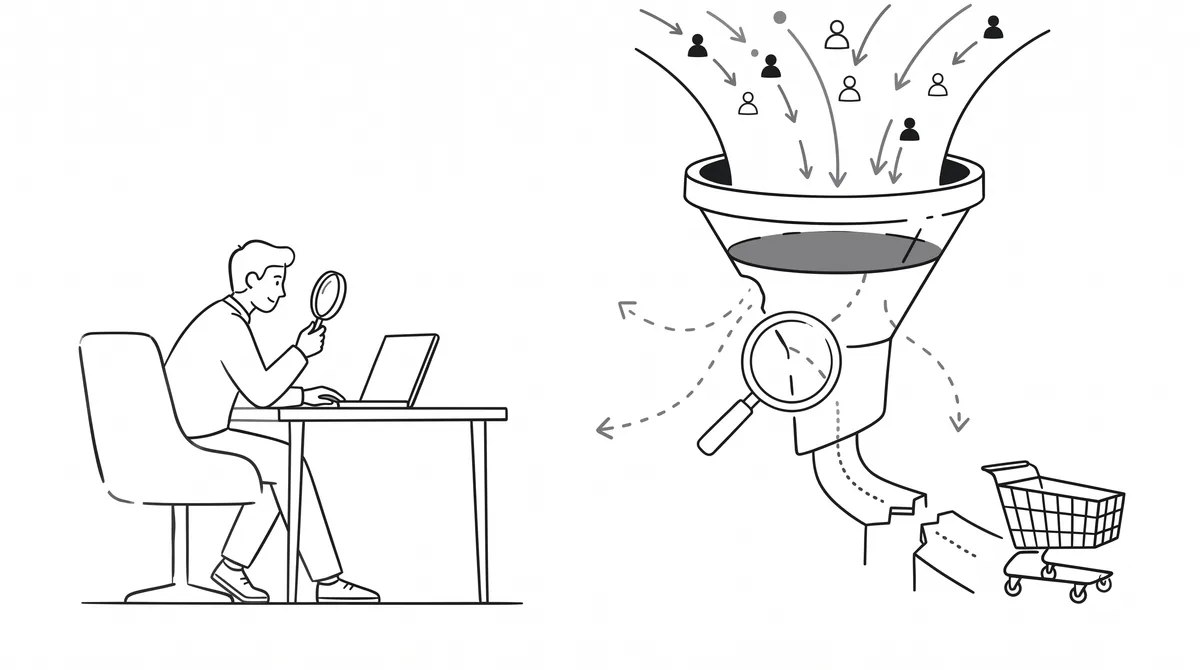
You are getting clicks, the ads work, the posts work, people arrive. And then nothing. Before you spend another dollar on traffic, understand this: a visitor who leaves is telling you something specific. There are only four places the leak can be, and you can find yours in an afternoon.
First, know what normal looks like
Conversion rates vary widely, and many websites sit in the low single digits of percent. If 100 people visited and nobody bought, that might be a leak, or might just be a small sample. Under about 300 visitors, be patient before concluding anything. If 500 have been through and conversions round to zero, you have a real leak. Now find it.
Leak 1: the wrong traffic
The most common leak is upstream of the page: the visitors were never going to buy. Broad targeting, clickbait-y creative, or curiosity clicks produce traffic that bounces in seconds. Check: does your ad promise exactly what the page sells, to people who plausibly want it? A high bounce rate paired with seconds-long visits usually means the traffic, not the page, is the problem.
Leak 2: the offer
People arrived, scrolled, understood, and decided it was not worth it. This is a price-to-value verdict, and no button color fixes it. Test one honest change: a stronger guarantee, a clearer bundle, a first-time offer, or sharper proof of the outcome. If a meaningfully better offer does not move conversions, go back to leak 1.
Leak 3: friction
- ·Slow page: every extra second of load time loses buyers, especially on phones, where most of your traffic is
- ·Buried action: the thing you want them to do should be visible without scrolling and repeated down the page
- ·Long forms: every field you ask for costs completions. Name, contact, done
- ·Surprise costs at the end: unexpected fees at checkout are the classic cart-killer
Leak 4: trust
The visitor wanted it, could afford it, found the button, and hesitated, because nothing proved you are real. Reviews with names and photos, real pictures of your work or product (not stock), a physical address or face, clear refund terms. Trust gaps are invisible to you because you know you are legitimate; strangers do not.
Diagnose in order, traffic, offer, friction, trust, and change ONE thing at a time. Fix three things at once and you will never know which one worked, which means you cannot repeat it.
Work out how much traffic you actually need
Before you decide there is a leak, check whether you have enough visitors for the result you expect. For example, if you want 10 customers a month and about 2% of visitors buy, you need around 500 visitors. If only 100 arrive, even a healthy page would produce about two. Write down the three numbers (visitors, share who act, customers wanted) and see which one is out of line.
If your conversion rate is reasonable and you simply lack visitors, the problem is volume, not the page. If you have plenty of visitors and almost none act, you have a leak, and the four checks above will find it. The advertising budget calculator shows how many clicks and leads a budget buys in your industry, so you can see whether the traffic you are paying for should be producing more.
A 30-minute page audit
Open your page on your phone, since most visitors will see it there, and go down this list. Note every item that fails:
| Check | What good looks like | If it fails |
|---|---|---|
| The first screen | It says who you help and what you do, in plain words, without scrolling | Rewrite the headline around the visitor's problem |
| The action | One clear button or phone number, visible at once and repeated lower down | Remove competing links and make one action obvious |
| Load speed | The page appears quickly on a normal mobile connection | Compress images and remove heavy scripts |
| Proof | Real reviews, photos of real work, names and faces | Add the best three reviews near the action |
| Price clarity | The visitor can tell roughly what it costs, or how to find out | Add a starting price or a clear quote process |
| Form or checkout | Only the fields you truly need, with no surprise costs | Cut fields and show full cost early |
| Match with the ad | The page repeats the promise the ad made | Build a page for each ad, not one page for everything |
| Contact options | A way to call, message or book that works | Test every link and form yourself |
Read your analytics without drowning
You need only a handful of signals. Look at where visitors come from, which pages they land on, how long they stay, what device they use and where they leave. If most of your traffic arrives from one ad and leaves within seconds, the audience or the promise is off. If people read the page and leave at the price or the form, the offer or friction is the issue. If they never reach the key part of the page, the layout or speed is the problem. Many free tools can show these, including the analytics already linked to your website.
Run tests properly: one change, enough visitors
- 1.Pick the leak you diagnosed and write your guess: "I think a clearer headline will raise enquiries."
- 2.Change only that one thing, so you can credit any difference to it.
- 3.Decide in advance how many visitors you need before judging, and do not stop early because of a lucky or unlucky day.
- 4.Compare the result with the version before. Keep the winner, then move to the next leak.
If you do not have enough traffic to test, make the change anyway and rely on judgement from customer conversations, as covered in the audience guide.
Offer tests that are worth trying
- ·A stronger guarantee, such as a clear satisfaction promise or a written fixed quote.
- ·A first-time bundle or starter option that lowers the risk of trying you.
- ·A faster path to a decision, such as free same-day quotes or an instant booking link.
- ·A sharper statement of the outcome, in the customer's words from your interviews or reviews.
- ·A simpler choice, with fewer options so the visitor is not overwhelmed.
When it really is the traffic
If the page checks out and the offer is sound, look upstream. Signs of poor-fit traffic include very short visits, many clicks from places you do not serve, searches that are only loosely related, or ad clicks that outnumber real enquiries. Tighten the targeting, add negative keywords on search ads, narrow the location, and make the ad say clearly who the offer is for and what it costs, so the wrong people do not click. The Facebook versus Google comparison explains why different platforms bring different intent.
Quick trust upgrades that cost almost nothing
- ·Put your real name, photo and location on the page, so visitors can see a person is behind it.
- ·Show three recent reviews with names near the main action, not hidden at the bottom.
- ·State your refund, guarantee or cancellation terms in one clear sentence.
- ·Add photos of real work or real products, and remove any generic stock images.
- ·Make sure your contact details match your Google listing and other directories.
Check the follow-up, too
A sale can fail after the form is filled in. If leads arrive but few become customers, look at how quickly and how well you respond. Reply fast, answer the real question, and follow up if you hear nothing. Count leads and customers separately, because the cost of each tells you where the problem sits. The CAC calculator turns spend and customers into a cost per customer you can compare with what a customer is worth.
Frequently asked questions
How long should I wait before deciding my site has a problem?
Wait until you have a meaningful number of visitors, enough that a few chance results cannot explain the picture. Small samples mislead, so be patient before concluding there is a leak.
Is a low conversion rate always bad?
No. It depends on the price, the market and where the traffic comes from. High-priced, considered purchases convert at lower rates than simple, cheap ones. Compare yourself with your own past results and your industry, not with a general figure.
Should I spend more on ads to get more sales?
Not until the page converts reasonably, or you will pay more for the same leak. Fix the biggest leak first, then scale traffic. See how much to spend on marketing for setting the budget.
What is the quickest fix with the biggest effect?
Usually the first screen and the action: say clearly who you help, and make it obvious what to do next. Then add real proof near the action, such as the reviews you collect.
Check your numbers against your industry
The free tool shows the conversion and cost benchmarks for your exact business type, so you know whether your funnel is actually broken or just normal and small. Sixty seconds, no signup.
Get a marketing plan for your business
Channels, budget math, audience, and hidden platforms, matched to your exact business and country. Free, no signup.
Build my free strategyRelated business guides