How to Write a Marketing Plan in One Page (Template Included)
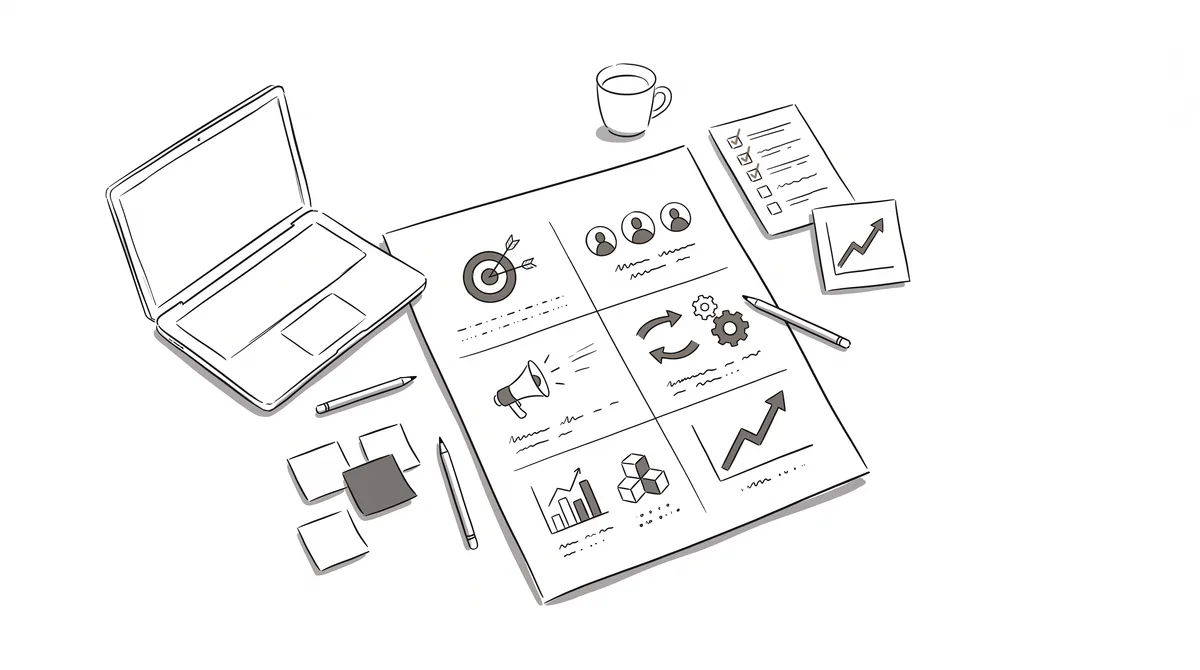
Search "marketing plan template" and you get 40-page documents with SWOT grids and mission statements, built for corporate approval meetings, not for getting customers. A small business marketing plan is seven questions on one page. If the answers are honest, it beats any deck.
The seven questions
- ·1. WHO exactly is the customer? One specific person, not a demographic. "Homeowners 30-55" is weak; "a homeowner whose AC just died in July" writes your ads for you
- ·2. WHAT do they get from you, in their words? Not features, the outcome they would tell a friend about
- ·3. WHY you and not the competitor next door? One sentence. If you cannot answer this, fix it before spending anything
- ·4. WHERE will they find you? Pick ONE hero channel to go deep on, plus one free supporting channel. Not five
- ·5. HOW MUCH will you spend monthly, an amount you can sustain for six months without panic?
- ·6. WHAT NUMBER tells you it is working? Expected cost per customer vs. what a customer is worth. Two numbers, one comparison
- ·7. WHEN do you review and decide? A fixed monthly date where you scale what worked or fix what leaked, never both at once
The plan is not the document; the plan is the discipline. A mediocre strategy reviewed every month outperforms a brilliant strategy nobody measures.
Worked example: a mobile detailer
Who: car owners in three specific suburbs who care about their car but not enough to spend Saturday washing it. What: showroom-clean without leaving your driveway. Why us: we come to you, book in 60 seconds, photos of every finished job. Where: Google Business Profile plus Local Services Ads (hero), before/after reels on Instagram (support). Budget: $400/month. Number: a detail customer is worth about $120 first visit; plan works if a booking costs under $40. Review: first Sunday of each month.
That is the whole plan. It fits on an index card, and every dollar and hour now has a job.
The mistakes that kill one-page plans
- ·Vague answers that feel complete ("quality service" is not a why-you)
- ·Choosing channels by comfort instead of by where the customer looks
- ·A budget you can only sustain for one month, marketing rarely pays back that fast
- ·Skipping question 6: without the two numbers, you cannot tell working from wishful
A second worked example: an online candle shop
The mobile detailer above is a local service. Here is the same plan, as an example, for an online product business. The figures show the method and are not a forecast:
| Question | Answer |
|---|---|
| 1. Who | Gift buyers aged 25 to 45 who want something thoughtful and handmade for a friend or partner |
| 2. What they get | A gift that looks and smells special, delivered ready to give |
| 3. Why us | Small-batch, hand-poured, with a handwritten note and a clear delivery date |
| 4. Where | Instagram short videos (hero) and email to past buyers (free support) |
| 5. How much | $300 a month for ads, plus a few hours a week on content |
| 6. The number | A first order is worth about $45, so the plan works if a customer costs under $20 |
| 7. When to review | First Sunday of every month |
Notice how each answer is specific enough to act on. For example, if the first month shows customers costing $35, the review has a clear decision: improve the page and the offer before adding budget, or test a cheaper channel such as email to existing customers.
Choosing your hero channel: a decision aid
Question four trips up many plans because the choice feels risky. Use the buyer's behaviour, not your own preference, to decide:
| If your buyers... | Lean toward | Because |
|---|---|---|
| Search for you when they need you | Google search and your Business Profile | They are already looking, so you meet them at the moment of need |
| Buy on impulse after seeing something appealing | Instagram or TikTok video and ads | The product sells by being seen |
| Buy after research and comparison | Content, reviews and email | Trust takes time and proof |
| Come from other people | Referrals and partnerships | A recommendation carries the sale |
| Are other businesses | LinkedIn and direct outreach | Decision makers are reached through people and proof |
Pick one from the table and support it with one free channel, as in the free marketing guide. If you are torn between paid options, the Facebook versus Google comparison explains the trade-off in more detail.
How to answer question six with real numbers
Question six is where most plans stay vague, so give it extra care. You need two figures: what a customer is likely to cost, and what a customer is worth. For the first, use a benchmark for your industry as a starting point. The advertising budget calculator shows average costs per click and per lead for 23 industries, which you can turn into a cost per customer using your close rate. For the second, take your average first-order profit, and if people come back, add what repeat orders are worth. Compare the two. If a customer costs less than they are worth, the plan can work.
Test each answer before you rely on it
| Question | It passes if |
|---|---|
| Who | You can name where to find ten of them this week |
| What they get | A customer would repeat it to a friend in their own words |
| Why us | A competitor could not truthfully say the same sentence |
| Where | You can reach them there for the budget you chose |
| How much | You can pay it for six months without stress |
| The number | You can state a cost per customer and a customer value |
| When | The review date is already in your calendar |
If an answer fails its test, treat it as the next thing to work on, not as a reason to abandon the plan. A plan with one honest gap is better than a complete plan built on guesses.
Turn the plan into a calendar
A plan only works if it becomes dated tasks. For one month, put each item on a specific day:
| Week | Task | Time |
|---|---|---|
| 1 | Finish the one-sentence message and the page or profile your channel points to | 3 hours |
| 2 | Launch the hero channel with one offer and a capped budget | 3 hours |
| 3 | Add the free support channel, such as asking past customers for reviews or a referral | 2 hours |
| 4 | Compare numbers with question six and make one decision at the review | 2 hours |
A monthly review meeting, even if it is just you
- 1.Open the plan and your tracking sheet side by side.
- 2.Write down what you spent, how many customers arrived, and what each cost.
- 3.Compare the cost with what a customer is worth. Is the plan working, close or failing?
- 4.Choose one decision: scale what works, fix what leaks, or stop what does not.
- 5.Write the next month's single change at the top of the plan.
When to rewrite the plan
Keep the plan stable for at least a couple of months so you can read it, and rewrite it when something material changes: a new product, a new competitor, a price change, a shift in who is buying, or a result that shows the original assumption was wrong. Rewriting after every wobble means you never learn anything. If you are not sure the audience is right, revisit how to find your target audience first.
Plans that grow with you
As you grow, the same seven questions still work. Add a line for each new channel and each new audience, and keep a separate plan for each so the numbers stay readable. When your budget grows, use the marketing budget calculator to reset it as a share of revenue, and keep reviewing monthly. The first 30 days plan is a good guide for how to run the first cycle.
Frequently asked questions
Do I need a formal marketing plan?
A short one-page plan is enough for most small businesses. What matters is that it forces clear answers and a regular review, not that it looks formal.
How long should a marketing plan cover?
Plan in detail for the next month or quarter and loosely for the year. Markets and results change, so a detailed twelve-month plan is usually out of date within weeks.
What is the difference between a marketing plan and a strategy?
The strategy is the big choice about who you serve and why you win. The plan is the set of actions, budget and numbers that carry it out. The seven questions cover both in a page.
What if I cannot answer the questions?
Treat the gaps as your first tasks. Talk to customers, study competitors with the competitor research guide, and use the free plan tool to get benchmarks while you refine your answers.
Get questions 4-6 answered for you
The free tool answers the hardest questions with real benchmarks: the right hero channel for your business type, what a customer should cost in your country at your budget, and the break-even math, in about a minute.
Get a marketing plan for your business
Channels, budget math, audience, and hidden platforms, matched to your exact business and country. Free, no signup.
Build my free strategyRelated business guides