How to Market Your Business With No Money: 9 Free Channels That Work
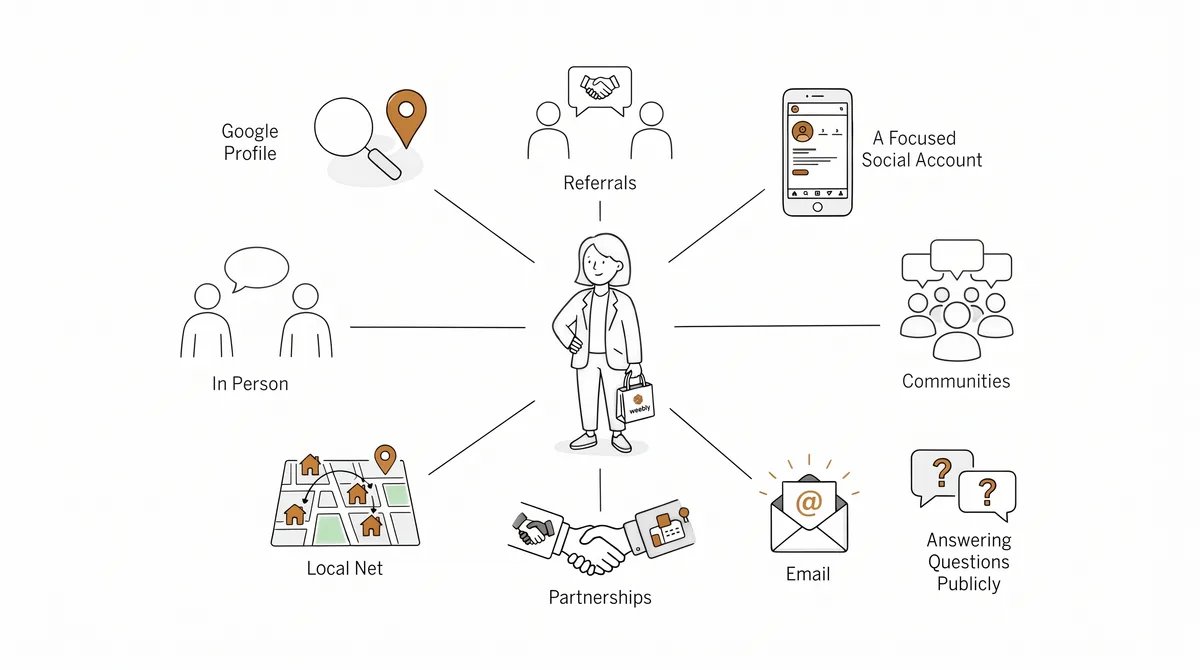
When you have no marketing budget, time becomes your currency. The good news: some of the highest-trust, highest-converting channels are free. Here are nine that work, roughly in the order most businesses should try them.
1. Google Business Profile
For any business with a location or service area, this is the highest-return free channel that exists. People searching "near me" are ready to buy today. Claim it, add real photos, collect reviews, and post weekly, active profiles rank higher in the local results.
2. Referrals
Your happy customers are your cheapest salespeople. Ask at the moment of peak happiness, right after you deliver a great result, and make sharing effortless with a simple link or card.
3. A focused social account
Pick one platform where your customers actually spend time and post consistently. For visual businesses that is Instagram or TikTok; for B2B it is LinkedIn. Consistency beats polish.
4. Communities and forums
Reddit, niche Facebook Groups, and Discord servers are full of people asking for exactly what you offer. Be genuinely useful for a couple of weeks before you ever mention your business, and let the value do the selling.
5. Answering questions publicly
Quora answers and helpful blog posts rank in Google for years. One good answer to a question your buyers ask keeps sending you customers long after you write it.
6. Email
The only audience you truly own. Email returns more per dollar than any other channel. Start collecting addresses now, even if your list is tiny, and send one useful message a week.
7. Partnerships
Find a business that serves the same customers but does not compete with you, and cross-promote. A florist and a wedding photographer, a gym and a nutritionist, each sends the other warm leads for free.
8. Nextdoor and local networks
For local businesses, neighborhood networks are full of people asking "does anyone know a good..." every day. Most competitors never claim their free page.
9. Showing up in person
Local events, markets, and meetups still work. Face-to-face builds trust faster than any ad, and it costs nothing but time.
Pick two of these, not all nine. Doing two consistently for a month beats doing nine for a week and quitting.
Free is not free: it costs your time
Every free channel has a price, and the price is hours. That is fine, as long as you count it. For example, if you spend five hours a week on free marketing and your time is worth $30 an hour, you are investing $150 a week, about $650 a month. The question is not whether free marketing is cheaper than ads, but whether the hours produce customers at a rate that beats the alternatives.
A useful test: once free channels are bringing in customers reliably, work out what you earn per hour of marketing time. When that number is high, protect those hours. When your time is better spent delivering the work, that is the moment paid advertising starts to make sense. You can see what paid leads cost in your industry in the advertising budget calculator.
How to choose your two channels
The callout above says to pick two of the nine. Here is how to choose them based on what you sell and who buys it:
| If you are... | Start with | Add |
|---|---|---|
| A local service business (plumber, cleaner, salon) | Google Business Profile | Referrals |
| A shop, cafe or restaurant | Google Business Profile | A focused Instagram account |
| A visual product or craft | One focused social account | |
| A B2B service or consultant | A focused LinkedIn presence | Partnerships and referrals |
| An expert with deep knowledge | Answering questions publicly | |
| A new business with no audience at all | Referrals from your warm circle | Communities where buyers ask |
A free 30-day plan on five hours a week
- 1.Week 1: claim and complete your Google Business Profile, and write your one-sentence reason people should choose you. Put that sentence on every profile.
- 2.Week 2: message 20 people who already know you and ask who they know that needs what you do. Ask for one review from your happiest past customer.
- 3.Week 3: choose your second channel and publish your first real piece of it: three helpful answers in a community, a post with a clear call to action, or a short email to past customers.
- 4.Week 4: look at what actually produced enquiries, drop the weaker channel and double the time on the stronger one.
This is the same discipline as the first 30 days plan, run at zero cash. The detail that matters most is the end of the month: decide what to keep based on enquiries, not on how the work felt.
Track every free customer back to a source
Free channels are the easiest to lose track of, and untracked work cannot be improved. Keep a simple sheet with four columns: date, customer, where they found you, and what they spent. Ask every new customer "how did you hear about us?" and log the answer. After a month you will know which channel is worth your hours, and you will have the data to decide whether paid advertising could do better. If you want to turn a source into a number, the customer acquisition cost calculator accepts your time cost as part of spend.
Mistakes that waste free effort
- ·Posting everywhere a little instead of somewhere properly. Two channels done consistently beat nine done for a week.
- ·Promoting before helping. In communities and forums, give useful answers for a couple of weeks before you ever mention your business, and never paste the same link repeatedly.
- ·Never asking. Most happy customers will refer or review if you simply ask at the right moment. The referral program guide shows how to make that ask automatic.
- ·Giving up before a channel can work. Search and community content builds slowly, so judge it over weeks, not days.
- ·Doing it without a clear offer. Free traffic to a vague proposition still converts poorly, so write the offer first.
Three messages you can copy and adapt
Most people stall on free marketing because they do not know what to say. These three templates cover the most common situations. Change the details so they sound like you.
Asking your warm circle for introductions
"Hi Sam, I have just started [business] and I help [who you serve] with [the problem]. I am looking for my first few customers. Do you know anyone who might need this? Even a name or an introduction would be a big help." It asks for a route, not a purchase, which makes it easy to say yes.
Answering a public question in a community
Write a genuinely useful answer first: the steps, the pitfalls, a rough price range. Only after that, add one line: "I do this for a living, so happy to look at your specific situation if that would help." Never open with your business and never paste the same reply twice.
Proposing a partnership to a nearby business
"Hi, I run [business] and we serve a lot of the same customers as you without competing. I would love to recommend you to mine, and I would be glad if you did the same. Could we swap a short mention or a joint offer?" Specific, mutual and easy to agree to. Follow up once if you do not hear back.
Frequently asked questions
Can you really get customers with no marketing budget?
Yes, many businesses win their first customers entirely through free channels, mainly referrals, their local Google listing and direct conversations. It takes time rather than money, and the first ten customers are usually won by hand. See how to get your first 10 customers.
Which free channel works fastest?
For most local businesses it is a complete Google Business Profile combined with a system for asking for reviews. For businesses without a physical location it is usually direct outreach and referrals from people who already know you.
When should I start paying for ads?
When free channels are bringing in customers reliably, you know what a customer is worth, and your own time is better spent serving customers than creating content. Use the marketing budget calculator to set a first paid budget you can sustain.
Is social media enough on its own?
Rarely. A social account is a good supporting channel, but people who are ready to buy tend to search. Pair it with a channel where buyers find you when they are already looking, such as a Google listing, or with referrals.
Find the right free channels for your business
Which of these fits depends on what you sell and who buys it. The free tool builds an organic-only plan for your exact business, including the hidden platforms most competitors ignore.
Get a marketing plan for your business
Channels, budget math, audience, and hidden platforms, matched to your exact business and country. Free, no signup.
Build my free strategyRelated business guides