How to Find Your Competitors' Weaknesses (Free Methods That Actually Work)
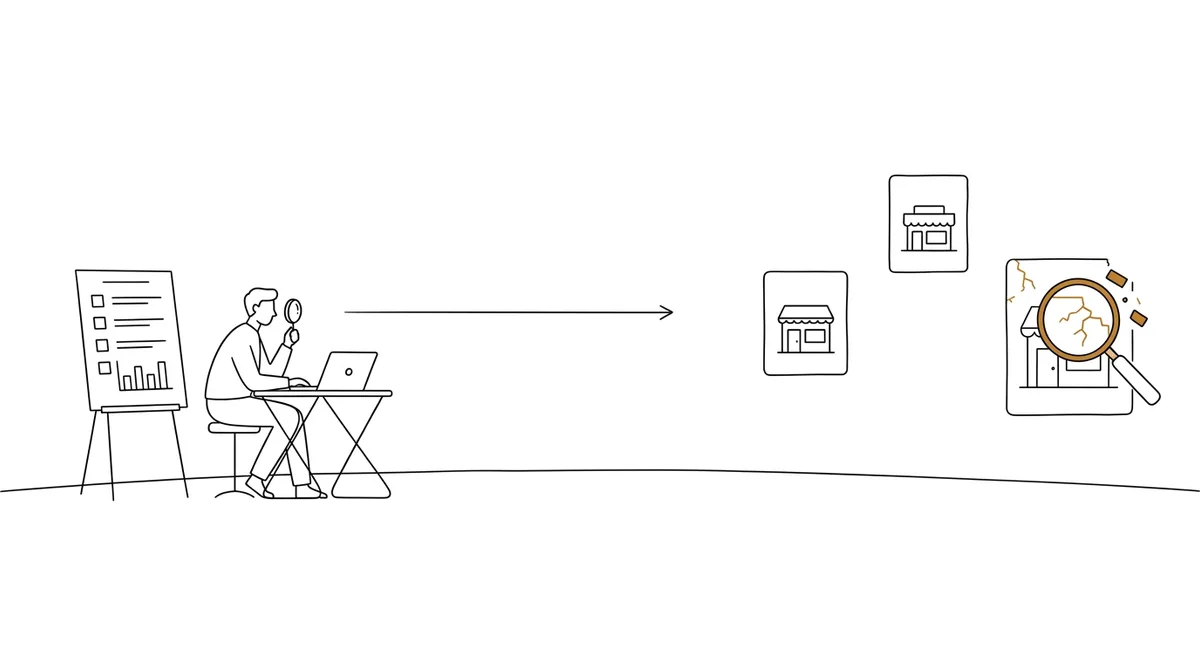
Most small businesses market blind: they know their competitors exist but not what those competitors do well or badly. That information is public, free, and takes an afternoon to collect. Here is the exact process.
1. Mine their worst reviews
Go to each competitor's Google, Yelp or Trustpilot page and read only the 1-3 star reviews. Ignore the one-off rants; look for complaints that repeat. "They never called back." "The price doubled after the quote." "Great product, three-week wait." Every repeated complaint is a sentence you can put in your own marketing: if their customers keep saying the quote was a surprise, your headline is about transparent pricing.
2. Check what ads they run (this is public)
The Meta Ad Library shows every Facebook and Instagram ad any business currently runs, free. Search your competitors. No ads at all? Paid social is open ground. Heavy install-focused ads? The small-job market may be ignored. Their ad copy also tells you what they think their strength is, so you can position against it.
3. Test their response time
Send each competitor a genuine-style inquiry through their website form or phone. Time the response. In many local-service markets, some businesses reply slowly or never; if that is true in your market, "we answer within the hour" is a real, provable advantage worth building your positioning on.
4. Compare their Google Business Profiles
- ·Review count and recency: an old business with few recent reviews is beatable in local search
- ·Photos: stale or missing photos are common and easy to out-do
- ·Hours, posts, Q&A: most profiles are neglected; a maintained one ranks better
5. Read their pricing page like a customer
Is the price public or "request a quote"? Are there fees revealed late? Do they force big commitments? Every friction point in their buying process is a smoothness you can offer. Some of the most effective positioning in any market is simply "the price we say is the price you pay".
6. Watch their social gaps
When did they last post? Do they answer comments? A competitor with 10,000 followers and dead comments has an audience nobody is talking to. Consistency beats size: showing up weekly in a neighborhood beats a big silent brand.
7. Ask their former customers
When a new customer switches to you, ask one question: "what made you leave?" Log every answer. After ten switchers you will know your competitor's biggest weakness better than they do.
The rule for using all of this: never attack competitors by name in your marketing. State the positive you offer ("same-day service, published prices") and let customers connect the dots themselves.
Build a one-page competitor scorecard
Collecting findings is easy. Using them is harder unless they are in one place. Make a simple table with one column per competitor, usually your three closest, and one row per signal below. Fill it in during a single afternoon and you will see the gaps at a glance.
| Signal | What to record | Why it matters |
|---|---|---|
| Reviews | Count, average rating, and how recent the latest ones are | Shows trust and whether the business is still active |
| Complaints | The two or three problems that repeat in low-star reviews | Your clearest positioning opening |
| Response time | How long a genuine enquiry took to get a reply | A proof point you can build on if everyone is slow |
| Pricing | Public prices, hidden fees, minimum commitments | Reveals where transparency is a differentiator |
| Offer | Guarantees, bundles, first-time deals | Shows what the market already expects |
| Ads | Which platforms, what message, what offer | Shows where they think the customers are |
| Social | How often they post and whether they answer comments | Reveals attention gaps you can fill |
| Website | Speed on a phone, clarity, whether you can book or call quickly | Friction you can remove for your own customers |
Score each signal from one to five, with five meaning strong. The rows where every competitor scores low are your best opportunities, because the whole market is leaving that need unmet. Keep the scorecard and update it each quarter, so you notice when a competitor fixes a gap or a new one opens.
Free tools for the research
- ·The Meta Ad Library shows every active Facebook and Instagram ad a business is running, with no account needed.
- ·Google's Ads Transparency Center lets you look up an advertiser and see the ads they run on Google.
- ·Google Maps lets you compare ratings, review dates, photos and answered questions side by side.
- ·A phone and a spare hour: call and message each competitor as a customer would, and note how they handle it.
- ·Their own website and pricing page, read on your phone, because that is how most customers will see them.
Turning weaknesses into positioning: three examples
For example, suppose you research three local competitors and find these patterns. Each one points to a message you could build a business around, and each is an illustration of the method rather than a finding about any real company:
| What you find | The opening it creates | How to say it |
|---|---|---|
| Reviews keep mentioning surprise charges on the final bill | Price transparency | "The price we quote is the price you pay." |
| Enquiries get a reply the next day, if at all | Speed of response | "We answer every enquiry within the hour." |
| Photos are old and the profile is neglected | Visible, active presence | Fresh photos of recent work and weekly posts |
Notice that none of the messages name a competitor. State what you offer and let customers connect the dots. That keeps you out of trouble and is usually more persuasive, because it sounds confident instead of defensive.
Where to put what you learn
- 1.Your headline and first paragraph on the page where most customers land.
- 2.Your Google Business Profile description, services and photos. The Google Business Profile guide shows how to complete each field.
- 3.Your ad copy, using the exact phrases unhappy customers used to describe the problem.
- 4.Your sales process, so the weakness becomes a promise you keep, such as a fast reply or a written quote.
- 5.Your review requests, so customers mention the strengths you want to be known for.
A one-afternoon schedule
- 1.Hour 1: list your three closest competitors and read their lowest-rated recent reviews. Write down repeated complaints.
- 2.Hour 2: check their ads in the Meta Ad Library and Google's Ads Transparency Center, then read their websites and pricing as a customer.
- 3.Hour 3: send each a real enquiry and note how long the reply takes. Compare their Google Business Profiles.
- 4.Hour 4: fill in the scorecard, circle the gaps, and write three sentences you could use in your marketing.
Put a rough value on each gap
A gap is only worth chasing if it pays. Estimate what closing it is worth before you invest. For example, if competitors reply slowly and you reply within the hour, ask how many more leads you could win from the same ad spend, and what each extra customer is worth to you. The advertising budget calculator lets you change the close rate and see the effect on customers and cost per customer. A small improvement in how many leads you close is often worth more than a larger advertising budget.
Stay honest and inside the rules
- ·Use only public information and your own genuine enquiries. Do not impersonate a customer to extract private data.
- ·Never post fake reviews, about a competitor or about yourself. They break platform rules and can get you banned.
- ·Do not copy competitors' wording or images. Use what you learn to differentiate, not imitate.
- ·Treat a single bad review as an anecdote. Look for patterns across many before you rely on a weakness.
Frequently asked questions
How many competitors should I research?
Three to five is enough. Pick the ones your customers actually compare you with, including one that is stronger than you, so you learn what winning looks like locally.
How often should I repeat this research?
Every few months, and whenever a new competitor opens or a big one changes its pricing or offer. A quick quarterly refresh keeps your positioning current.
What if my competitors have no weaknesses?
Every business has gaps, even if they are small. Look at who they serve badly, such as small jobs, last-minute requests or a particular neighbourhood, and whether you can serve that group better. Understanding your target audience helps you choose.
Can I automate this?
Partly. Tools can track ads and reviews, but the judgement about what matters is yours. The first 30 days plan shows how to turn findings into a first month of action.
Want it done for you?
Our Pro research report does this analysis automatically: it finds your real local competitors by name, reads their reviews and visible channels, and hands you the specific opening each one leaves, with ad copy written to exploit it.
Get a marketing plan for your business
Channels, budget math, audience, and hidden platforms, matched to your exact business and country. Free, no signup.
Build my free strategyRelated business guides