How to Use AI for Small Business Marketing (Without Learning Marketing First)
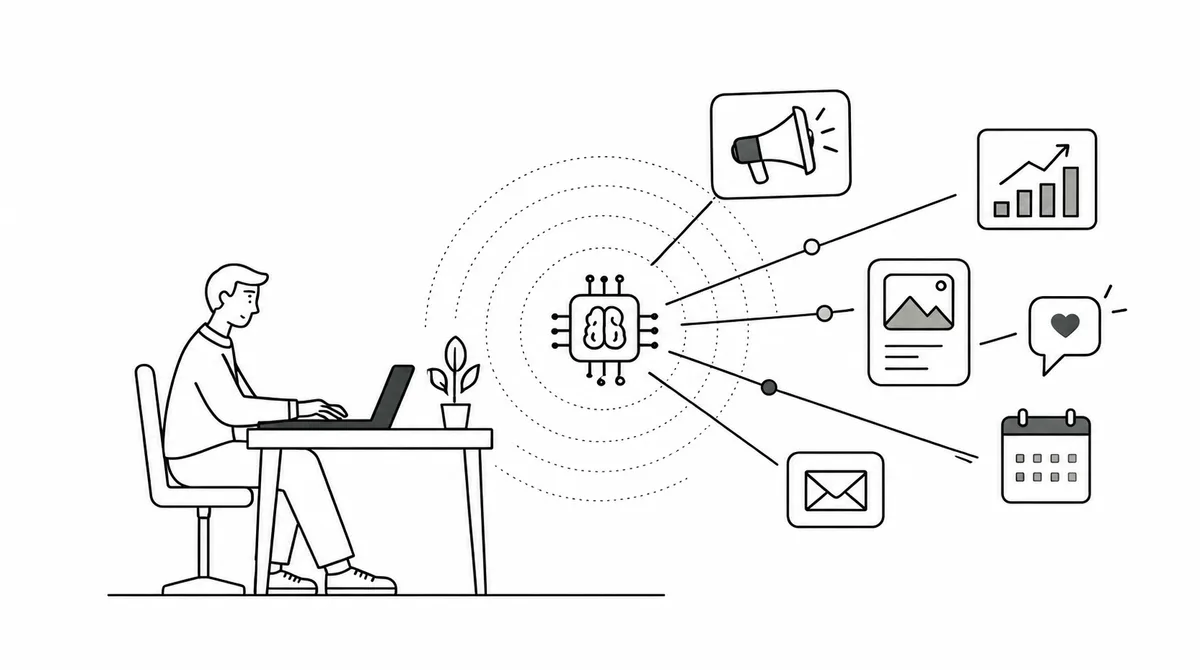
Every small business owner now has a marketing assistant that costs $20 a month or nothing: ChatGPT, Claude, Gemini. Used well, AI genuinely replaces hours of work. Used naively, it produces confident, generic advice that sounds right and performs badly. The difference is one thing: context.
What AI is genuinely great at
- ·Writing variations: give it one good ad and it writes ten more in seconds
- ·First drafts: social posts, email sequences, offer descriptions, review replies
- ·Explaining anything: paste any marketing term or report and ask "explain this simply"
- ·Being available: it answers the 11pm "should I raise my prices?" question immediately
The blind spot: AI does not know your market
Ask a chatbot "how should I market my gym?" and it gives the same answer it gives every gym on earth: post on Instagram, run a referral program, try local ads. It does not know your city's ad costs, your competitors' weaknesses, or that the studio across the street just dropped its prices. Generic input, generic output. This is why AI marketing advice so often feels right and does nothing.
The fix: give your AI a research report first
AI assistants transform when you hand them real, specific facts. The workflow that works: get a proper research report on YOUR business and market (real competitors, real local costs, a real plan), upload the PDF to your AI, and from that moment every answer is grounded in your actual situation.
- ·"Write 5 Facebook ads using the positioning and offers in this report"
- ·"My cost per lead came in at $42 and the report expected $25. What does the report say to do?"
- ·"Rewrite the week-3 plan for someone with only 5 hours a week"
- ·"Draft the review-request text message the report recommends"
One good report turns a generic chatbot into a marketing advisor that knows your market. The AI supplies the endless patience; the report supplies the truth.
A month of this workflow, concretely
- ·Week 1: upload the report, ask the AI to turn the 30-day plan into calendar tasks sized to your week
- ·Week 2: paste in your first real numbers (spend, clicks, leads) and ask how they compare to the report's expectations
- ·Week 3: have it write variations of whatever ad performed best
- ·Week 4: ask "based on the report's decision rules and my numbers, do I scale, hold, or fix something first?"
A starter prompt library you can copy
Good prompts give the AI context, a task and a format. Replace the brackets with your details. These cover the jobs small businesses ask for most:
| Job | Prompt to start from |
|---|---|
| Positioning | "I run [business] in [city]. My customers are [who]. Competitors do [what]. Write three one-sentence positioning statements that stress [your edge]." |
| Ad variations | "Here is my best-performing ad: [paste]. Write ten variations, each with a different hook, under [length]." |
| Review replies | "Write a warm, specific reply to this review: [paste]. Mention [detail]. Keep it under 60 words and do not make promises." |
| "Write a short email to past customers about [offer]. Tone: friendly and direct. One link, one call to action." | |
| Content ideas | "List 20 questions a customer asking about [service] would type into Google, grouped by how close they are to buying." |
| Weekly plan | "I have [hours] a week for marketing. Turn this plan into a Monday to Friday task list: [paste]." |
Give the AI facts, then check its output
AI writes fluently whether or not it is right. It can state a price, a statistic or a law that does not exist, so treat every factual claim as a draft to verify. A reliable routine is: supply your real facts and constraints, ask for a draft, then check names, numbers, claims and tone before anything goes public. If the AI quotes a figure you did not give it, find the source or remove it.
Keep your own voice
Customers can tell when every business sounds the same. After a first draft, add one real detail only you know: a customer story, a specific job, a view you hold. Paste two or three of your best past messages into the prompt and ask the AI to match that style. Read the result aloud. If you would not say it, change it. A few minutes of editing is the difference between copy that sounds like a template and copy that sounds like the person customers will actually meet.
Privacy and rules to follow
- ·Do not paste customer names, contact details or private records into a public AI tool. Remove identifying details first.
- ·Check the terms of the tool you use about how your inputs are stored and used.
- ·Follow advertising rules for your industry. AI does not know that you cannot promise medical or financial results.
- ·Be honest about reviews and testimonials. Never have AI invent a customer quote.
What not to automate
- ·Replies to upset customers, which need a human who understands the situation.
- ·Anything that makes a legal, medical or financial claim.
- ·Your core promise and pricing, which are business decisions, not writing tasks.
- ·Real customer relationships. AI can draft the message, but a person should send the follow-up that matters.
Use AI to read your numbers, too
AI is useful for explaining results. Paste in your spend, clicks, leads and customers and ask it to calculate cost per lead and cost per customer, then to compare them with a benchmark you give it. For example, give it your industry's average cost per lead from the advertising budget calculator and ask whether your result is above or below it, and what to test next. The arithmetic can be checked in the CAC calculator if you want to be sure.
Three small projects to try this week
- 1.Rewrite your headline. Give the AI your audience and your main benefit and ask for ten headlines in different styles. Pick two you like, put each on the page in turn, and see which gets more enquiries.
- 2.Answer real questions. List the five questions customers ask you most often, ask the AI for a clear draft answer to each, then edit them with your real details. Publish them as a FAQ section and as short posts. If you are unsure which questions matter, interview a few customers first.
- 3.Summarise your reviews. Paste in your recent reviews with names removed and ask for the themes: what customers praise, what they complain about, and which words they use. Use the praise in your marketing and fix the complaints.
Signs the output is too generic
- ·It could describe any business in your industry if you swapped the name.
- ·It uses phrases like "high quality" and "customer focused" with no proof.
- ·It makes claims you cannot back up.
- ·It ignores your location, price point or the specific problem you solve.
When you see these signs, do not accept the draft. Add a real detail, a real number or a real example, and ask the AI to rewrite around it. Specific input is the cure for generic output.
A simple weekly AI routine
- 1.Monday: ask the AI to turn your plan into this week's tasks sized to your available hours.
- 2.Tuesday and Wednesday: draft posts, emails or ad variations, then edit them in your voice.
- 3.Thursday: reply to reviews and messages with AI-assisted drafts you personalise.
- 4.Friday: paste in the week's numbers and ask what changed, what to keep and what to try next, then decide for yourself.
Frequently asked questions
Can AI replace a marketing person?
It can replace a lot of drafting and routine work, but not judgement about your customers, your pricing or your reputation. Many small businesses use AI as an assistant and still make the decisions themselves. If you are weighing a hire, see whether to hire an agency.
Which AI tool is best for marketing?
The popular assistants all handle copywriting and planning well. The bigger difference comes from the context you give them, not the brand. Start with whichever you already use and improve your prompts.
Is AI-written content bad for search?
Search engines care about whether content is helpful and accurate, not how it was drafted. Content that is generic, inaccurate or mass-produced tends to perform poorly. Add real experience and verified facts to anything you publish.
How do I stop AI giving generic advice?
Give it specifics: your business type, location, budget, customers and competitors. The more real facts it has, the more specific its answer. You can start from the free marketing plan, which gives you a fact-based plan to paste in.
Where to get the report
Our free tool builds a benchmark-based plan for your business type and budget in a minute, and the PDF works exactly this way with any AI. Pro reports go further: live research on your named competitors and your city's current costs, which gives your AI even more real material to work with. Either way, the principle is the same: feed your AI facts, not vibes.
Get a marketing plan for your business
Channels, budget math, audience, and hidden platforms, matched to your exact business and country. Free, no signup.
Build my free strategyRelated business guides